MyCareer.NJ.gov: evidence for the next move
Role: Engineering lead, principal engineer, and primary engineer across three production codebases · 2022–2026
I led engineering from a 400-file prototype into a bilingual statewide decision service, built its program-level evidence, and did the 2023 data modeling that began the state's migration to Credential Engine's CTDL standard.
Evidence boundary
- Built
- Three production codebases, bilingual delivery, program report cards, CTDL interoperability, and shared AI controls
- Observed
- 1.8 million recorded active users since December 2023, 3,800+ training programs, and 400K+ résumés
- Not proved
- That platform exposure alone caused employment, earnings, enrollment, or training outcomes
Selected measures
- active users since December 1, 2023, verified July 17, 2026
- 1.8M
- active users in the verified trailing twelve months
- 635K
- approved training programs kept current and comparable during my stewardship
- 3,800+
- résumés integrated with millions of wage records and hundreds of thousands of outcomes
- 400K+
- training-catalog refresh after rebuilding the data operation
- 4× / day
- automated test coverage, alongside a 94% vulnerability reduction
- 0→93–96%
- registered CTDL Advisory Group member contributing practitioner input on interoperability
- 2025–2026
MyCareer.NJ.gov (opens in a new tab) helps a person move from a career question to comparable occupations, approved training, program outcomes, job openings, tuition help, and support services. I led engineering from the early prototype into the statewide platform as part of a larger government, research, design, product, and delivery partnership. I was the primary engineer across the public site, the Career Navigator application (opens in a new tab), and the FastAPI recommendation engine. The service is available in English and Spanish; that describes the product and reviewed language work, not my personal fluency.
From beta to statewide launch
The state released the first beta in 2022 and relaunched the expanded platform in March 2024 (opens in a new tab) after research and testing with residents, training providers, career coaches, and academic experts. A GA4 record verified July 17, 2026 shows 1.8 million active users since December 1, 2023, 635,000 in the trailing twelve months, a documented monthly-active range of 56,000 to 78,000, and more than 2.1 million cumulative active user-months. Active users are device-based and may include some out-of-state traffic. Those figures establish operating scale, not employment causality.
The public campaign had its own delivery arc
New Jersey supported the service with streaming video, paid social media, and display advertising created by the NJ Office of Innovation's Communication + Engagement Lab (now the New Jersey Innovation Authority) with the Department of Labor and Workforce Development. The media campaign began in October 2024, expanded in April 2025, and concluded in August 2025. Recorded campaign results (opens in a new tab) report more than 40.5 million video impressions, 1.2 million clicks, and a 1,400 percent year-over-year increase in site traffic. Those are campaign and platform measures. I include them to show the public launch around the product, not to claim individual authorship of the campaign or employment outcomes from an impression.
What I was responsible for
I owned the CI/CD pipeline, release and deployment tooling, database-migration suite, and bilingual locale middleware; I was a major co-author of the backend API composition. I architected and directed the broader full-stack system, including its Contentful, GraphQL, search, and ports-and-adapters shape, while other engineers implemented substantial parts of those layers. The archived public implementation record through November 2025 (opens in a new tab) covers every main-site surface and its delivery infrastructure; its own README explicitly excludes Career Navigator, whose work I document from my separate project record. Across the three codebases, the archived project record shows sustained primary-engineer ownership; I do not use the public main-site repository alone to quantify work it cannot show. Keeping that implementation public also makes it inspectable, reusable civic infrastructure for other states. This is evidence of sustained technical ownership inside a multi-organization effort, not sole authorship of the platform.
Hardening a public service
I led a zero-downtime GCP-to-AWS migration across compute, database, secrets, and clustered processes while the service stayed live. The product grew from roughly 400 files into more than 3,200 files and about 330,000 lines across three repositories, carrying more than 200 schema changes. Automated test coverage rose from essentially zero to 93–96 percent, known vulnerabilities fell from 163 to 10 with the backend at zero, and accessibility regression, coverage, Lighthouse, and security gates entered the public release path (opens in a new tab). Recorded monitoring showed 100 percent Core Web Vitals ‘Good’ across 199,574 URL assessments and 99 median desktop performance; organic search position moved from 35.7 to 9.1 while monthly clicks rose 403 percent. These are point-in-time engineering and discoverability measures, not a claim that every user experienced a barrier-free service.
A connected service, not a single tool
- Career Navigator (opens in a new tab) turns a résumé or work history into personalized career and training directions; it is the one surface maintained outside the main-site repository.
- Training Explorer (opens in a new tab) lets residents search, filter, compare, and inspect thousands of approved programs by cost, duration, location, accessibility, language, schedule, services, and outcomes.
- Career Pathways (opens in a new tab) connects progressive roles and credentials in major industries to detailed occupation pages (opens in a new tab) and the state's in-demand list (opens in a new tab); the public pathway implementation (opens in a new tab) connects roles to tasks, credentials, advancement, jobs, training, and financial support.
- Support resources (opens in a new tab) carry the decision into barrier removal, including a dedicated tuition-assistance collection (opens in a new tab).
- Provider resources (opens in a new tab) make the operating side visible: eligibility, quarterly reporting, renewal, and the consumer-protection purpose of the Eligible Training Provider List.
The deployed Career Navigator beta operationalized inherited DOORS and RIPL/Rutgers econometric work; it is not the separate 2026 conversational proof of concept. It combined 400K+ résumés, de-identified wage records, NLx job data, and observed worker transitions to rank career and training directions. New Jersey's AI Task Force report (opens in a new tab) describes factors including sufficient openings, training or career moves by workers with similar skills, and potential wage gains. I engineered and operated the production system; I did not originate the underlying econometric models.
First, an occupational foundation
Before the report cards, I led the architecture of an occupational layer that began with O*NET Web Services (opens in a new tab) for occupation definitions and tasks, then added the CareerOneStop API (opens in a new tab) and NLx job signals to that foundation. The public occupation-detail composition (opens in a new tab) combines those sources with New Jersey salary, demand, education, and related training. The public data model (opens in a new tab) shows how BLS education data and NCES CIP/SOC crosswalks connect occupation profiles to ETPL programs and outcomes. The record also documents a 2025 consistency fix (opens in a new tab) that kept displayed job counts and outbound searches on the same SOC identifier. My role was to direct and integrate the system; substantial client modules were team-authored.
Then, program outcomes became a product surface
I added the program-level consumer report cards (opens in a new tab) using data collected by Rutgers’ Heldrich Center for Workforce Development (opens in a new tab). Each card makes completion, employment at six and twelve months, median annual earnings at six and twelve months, and top industries visible at the point of comparison. Heldrich calculates the underlying performance measures from state administrative and wage-record data; my contribution was turning that evidence into a legible program-level decision surface. The point was not another directory. It was a way to compare consequential choices using public data in terms a person could act on.
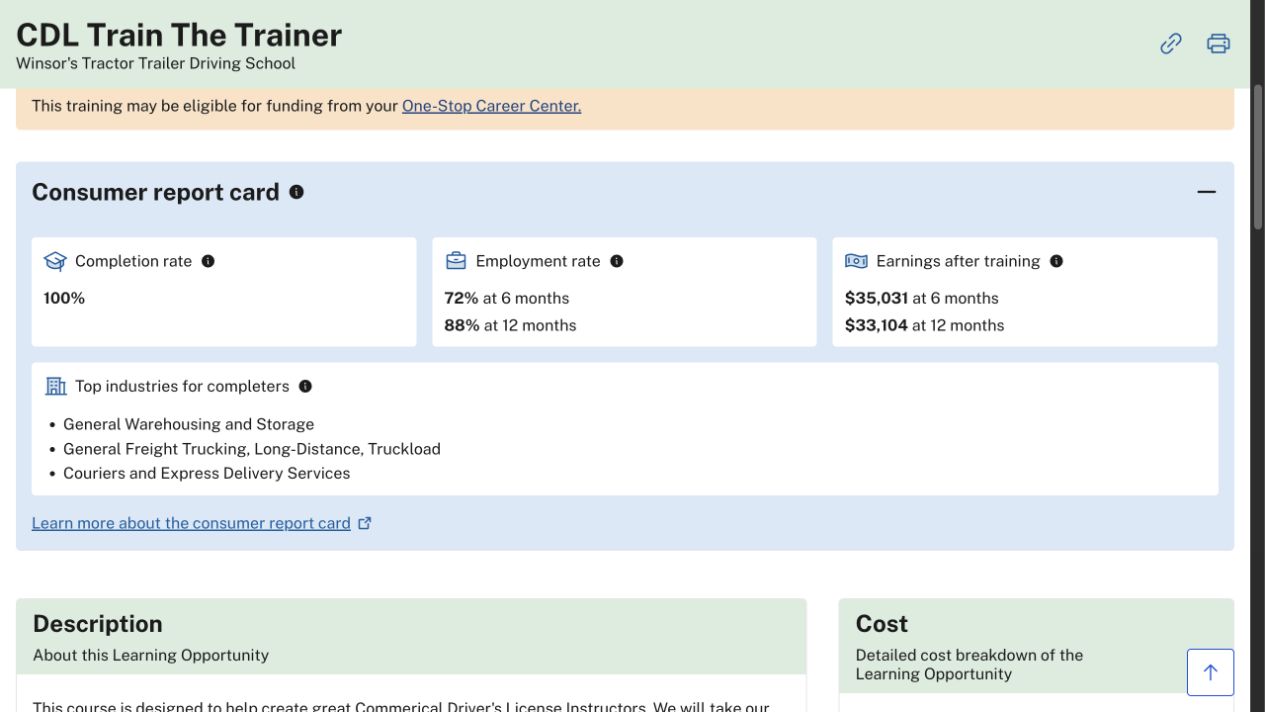
A program-level example
A program-level example provided for this case study includes a 97% completion rate; 66% employment at six months and 66% at twelve months; and earnings after training of $32,584 at six months and $56,654 at twelve months.
- General Freight Trucking, Long-Distance, Truckload
- General Freight Trucking, Local
- General Warehousing and Storage
Accountability stayed visible
Program pages warn when small cohorts limit reliability, leave missing results explicit, and let residents report incorrect program information. The public data-source explanations (opens in a new tab) date and caveat time-sensitive job signals; on the operating side, provider reporting and quality assurance (opens in a new tab) connect public visibility and training-funding eligibility to quarterly data work. Evidence helps only if its limits and correction path remain part of the interface.
The catalog was an operation, not a snapshot
For more than three years I kept 3,800+ approved ETPL programs (opens in a new tab) current every week without a lapse. I diagnosed pipeline defects that silently suppressed hundreds of valid listings, repaired the data path, and rebuilt refresh from a slower batch into a four-times-daily operation. I also made reviewed English and Spanish interface-copy parity enforceable in delivery; the current Training Explorer search (opens in a new tab) still warns that free-text queries must be in English. The public data model (opens in a new tab) shows how program identifiers, costs, credentials, accessibility, language, child-care, schedule, and CTDL fields traveled through the catalog. A program that exists upstream but disappears from search is not a minor data-quality issue; it is a public option removed from a resident's world.
Interoperability was the product strategy
I led the MyCareer engineering implementation supporting New Jersey's move to publish workforce training and credential data through Credential Engine (opens in a new tab) using CTDL, the Credential Transparency Description Language (opens in a new tab). CTDL is a semantic linked-data standard for search, discovery, and cross-system interoperability. The architectural throughline was portability: programs, organizations, credentials, support services, occupations, and outcomes should remain machine-readable and comparable beyond one interface, agency, or vendor boundary.
On the publishing side, I coordinated the cross-system mapping and release path for state program data. On the consuming side, I built the integration controls that normalized CTDL learning opportunities, organizations, credentials, and support services from the Credential Registry (opens in a new tab) into the existing public Training Explorer contract. Publisher validation, full and incremental synchronization, auditable runs, transactional retries, retained identifiers, and local fallback made reconciliation inspectable and kept an upstream outage from breaking program detail pages. The consuming capability was feature-gated, so I describe it as implemented interoperability architecture—not universally active production behavior.
I also brought that New Jersey implementation experience to Credential Engine as a registered member of its CTDL Advisory Group (opens in a new tab) from January 2025 through July 2026, contributing practitioner input in recurring meetings. Credential Engine's public page describes open participation but lists principal members only; I am not claiming principal-member status.
What the numbers do not say
The 1.8 million active-user figure belongs to the platform and partnership. It is separate from the completion, employment, and earnings records the product publishes by program. Those outcome records describe observed cohorts from wage-record matching; they do not establish that the website—or one engineer—caused an employment outcome. Campaign impressions are a third measure. I keep all three separate because operating scale, decision evidence, and causal impact are different claims.
The platform's approved program, occupation, wage, and support-service data became the evidence base for the separate career-coach proof of concept. The platform served residents; the shared AI guardrails shipped later; the conversational coach itself did not launch.
Public launch, peer recognition, and outside context
New Jersey put a visible public deadline behind the service. The MyCareer.NJ.gov statewide campaign commercial (opens in a new tab) shows the campaign residents saw. I led engineering delivery to the launch; the NJ Office of Innovation’s Communication + Engagement Lab (now the New Jersey Innovation Authority) and NJDOL created and ran the campaign.
The Labor Market Information Institute (opens in a new tab) supports the state professionals who produce and interpret workforce data. In 2026, it gave the New Jersey Department of Labor and Workforce Development (NJDOL) its Best State LMI Focus on Impact and Sustainability award for the department’s evidence-based approach and MyCareer.NJ.gov (opens in a new tab). The Institute's awards recognize state work that can serve as an example to other states. This is NJDOL and project recognition—not a personal award.
The National Association of State Workforce Agencies (NASWA) (opens in a new tab) represents the workforce agencies of all 50 states, D.C., and U.S. territories. Its official nominations index (opens in a new tab) lists MyCareer.NJ.gov among the 2025 Data Insights and Innovations nominees, without the asterisk used for winners. That is a peer-ecosystem nomination—not a win or a personal award.
- New Jersey Office of Innovation: a first-party project overview from a state delivery partner (opens in a new tab)
- Harvard Project on Workforce: Training Explorer provides a promising potential model for public training (opens in a new tab)
- Fast Company: project-partner context by NJ Office of Innovation founder and unpaid adviser Beth Simone Noveck (opens in a new tab)
- Royal Statistical Society's Real World Data Science: Career Navigator in a workforce-AI series (opens in a new tab)
- ROI-NJ: New Jersey business-news coverage of the statewide launch (opens in a new tab)