Area
Energy, climate & utilities
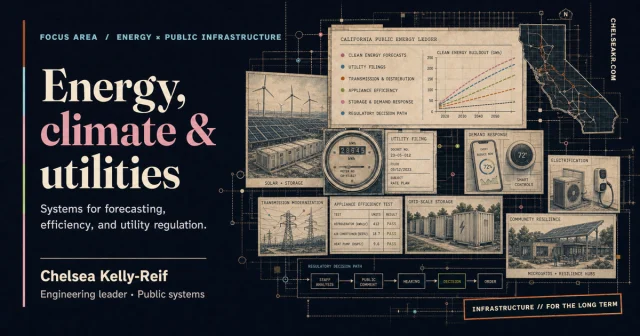
I built and operated systems California uses for energy forecasting, appliance efficiency, and utility regulation. It is the climate work I most want to return to as an engineering leader.
Tools you can use today

qfer-preflight (opens in a new tab)
An offline pre-submission validator for California Energy Commission QFER consumption CSV filings: a filer runs it on their own file before uploading, and every finding cites the published instruction it came from. Anything the tool cannot check is reported as not evaluated, never as a pass, and filing data never leaves the filer's machine. Independent and unaffiliated with the CEC; the Commission's portal remains the authoritative validator.

power-content-check (opens in a new tab)
A deterministic conformance checker for California Power Content Labels against the format prescribed in Title 20 CCR section 1393.1. It reports which prescribed elements a label carries, which it lacks, and which it cannot judge. It makes no judgment about any supplier's power mix, produces no ranking, and makes no compliance determination, which only the Energy Commission can make. Unaffiliated with the CEC or any utility.

ca-tariff-parse (opens in a new tab)
A deterministic parser that turns published California electricity rate schedules, including SMUD and PG&E documents, into structured data with a citation for every value: document, page, section, and line. A coverage command reports exactly how much of each document was accounted for, so what the parser missed is as visible as what it read. Not rate advice, not a bill estimate, and unaffiliated with any utility.

inspected (opens in a new tab)
A measurement over two public datasets: CAL FIRE's 132,522 wildfire damage-inspection records and the CEC's published electric service territory boundaries. 37.9 percent of records fall inside more than one published boundary, every rate carries its denominator and a confidence interval, and no utility is ranked. Figures are pinned to dated retrievals and move only when those retrievals are deliberately refreshed. Unofficial.
Record
Social services, energy, and utilities
Resident services, caregiver background checks, regulatory energy data, certification workflows, licensing, and claims systems.
Open source
Swelter
Maturity: Reference implementation
A maintained reference implementation for community-owned heat and air-quality sensing. Its bilingual dashboard shows daily Copernicus model data for 337 California cities and provisional readings from physical, uncalibrated low-cost sensors in Stuttgart. The pipeline keeps raw and calibrated values separate and exports OGC SensorThings data. It is not an established community sensing network, and manual accessibility review remains a separate gate.
Questions I get asked
What did you build for California's energy data?
I designed and shipped the Energy Commission's AWS Data Submission Portal for petroleum and quarterly fuel-and-energy reporting. That data feeds California's statewide demand forecasts and the Integrated Energy Policy Report. The commission later expanded the platform across the agency and into residential solar-permit reporting.
What is MAEDbS, and what did you do there?
I maintained and operated MAEDbS, California's system of record for Title 20 appliance-efficiency certification. Manufacturers, laboratories, and retailers use it to check which products can be sold in the state. My job was to keep it reliable and protect the data.
How did you modernize the state's energy-data infrastructure?
I built data pipelines and policy dashboards, then worked with petroleum operators, power-plant operators, and commission leaders to move the reporting system to the cloud without losing the people who had to use it.
What did you build for California's utilities regulation?
At the Public Utilities Commission, I directed the statewide Transportation Carrier Portal and designed eCAP for telecommunications-access claims and broadband-grant payments. Both replaced slower, fragmented regulatory processes.