Area
Transit data quality & open standards
Riders can only trust an app as much as the data behind it. I build and operate public services that score and validate the open data transit runs on: GTFS, GTFS Realtime, and the Transit Operational Data Standard.
Tools you can use today
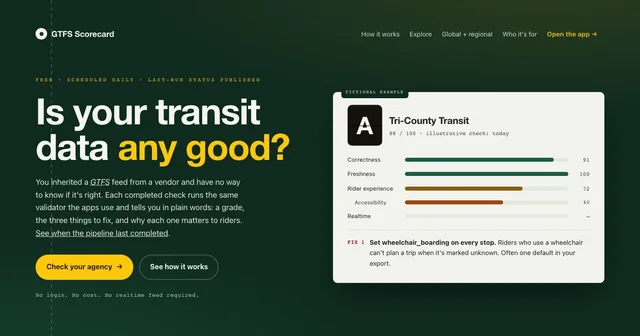
GTFS Scorecard: plain-language quality for transit feeds
I run GTFS Scorecard, a live service that reads more than 2,100 published GTFS feed records and turns each one into a plain-language scorecard with a first recommended fix. Structural correctness comes from MobilityData's canonical validator; the scorecard adds freshness, rider-information, and realtime checks on top. Feed records are not necessarily distinct agencies, and no agency is known to have adopted a scorecard into its workflow.

TODS Validate: findings a scheduler can act on
I build tods-validate, a beta validator for the Transit Operational Data Standard, the open standard for crew runs, deadheads, and vehicle assignments that rides as an overlay on an agency's GTFS feed. It checks a package against TODS v2.1.0 and reports what is wrong, where, and what good looks like, with the spec section cited behind every finding. No agency adoption or production use is claimed.
Open source
Transit Delivery Atlas
Maturity: Early public release
An active, independent crosswalk of California Executive Order N-7-26. It keeps the signed source, selectively reviewed public evidence, and my analysis separate across 21 directive records. It is not an official implementation or compliance dashboard; missing evidence does not show that work did not occur, and analytical relationships are not official ownership or a critical path.
NearMiss
Maturity: Public beta
A beta road-safety toolkit and public FARS evidence atlas. The live atlas presents reviewed 2020–2024 NHTSA fatal-crash counts for all 50 states and Washington, D.C., labeled as burden rather than exposure-normalized risk. Separate local workflows use synthetic reports to demonstrate privacy-preserving intake, exposure normalization, uncertainty intervals, and hotspot analysis. Manual screen-reader review remains pending.
Fare Policy Assistant
Maturity: Deployed beta · reference implementation
A retrieval-grounded assistant that answers rider questions about fare and reduced-fare policies for a dozen-plus California transit agencies, built so its public evaluation harness has something to grade. Merge-blocking suites cover citations, refusals, forged conversation history, and English-Spanish parity, with versioned prompts and a committed regression baseline, and properties the harness has not measured are reported as not measured, never as passing. Ingesting real fare pages keeps surfacing findings: a current fares page still listing a pass product retired weeks earlier, and an inter-agency transfer published as good for 60 minutes on one agency's site with no window published on its partner's. It never determines anyone's eligibility.
Writing

The score was the easy part
I built GTFS Scorecard to turn transit-data findings into repairs. It taught me that civic technology earns trust through explicit judgment, honest unknowns, preserved evidence, and proof that a change reached the source.
A signed transit order starts the story
A practical way to read California transit policy through exact instructions, named agencies, inferred dependencies, and public evidence.
Questions I get asked
What do you actually run?
GTFS Scorecard is a live service at gtfsscorecard.org scoring a curated registry of more than 2,100 feed records on a daily schedule, publishing its evidence alongside a read API, a GitHub Marketplace Action, and a read-only MCP server. tods-validate is a published validator for the Transit Operational Data Standard on PyPI, shipping a CLI, container, GitHub Action, and browser playground. Both are open source, and both carry explicit maturity labels instead of implied guarantees.
How do you score a feed honestly?
The scorecard prioritizes rider-facing problems over validator noise, scores realtime quality only when a usable realtime feed is actually configured, and treats a feed that cannot be fetched differently from one that fetches and fails validation. A feed record is not always a distinct agency, and the public status page reports exact current counts with the latest completed run, so the published totals never outrun the evidence.
What does standards conformance mean in practice?
Checked against the specification, not against opinion. The validators are deterministic, and findings cite the requirement they violate, so an agency or vendor can argue with the spec rather than with me. That discipline came from doing the work: interoperability modeling for a state's credential data and daily operation of feed scoring taught me where specifications are precise and where real feeds force judgment calls.
Have you built transportation systems inside government?
At the California Public Utilities Commission I directed the statewide Transportation Carrier Portal to its June 2021 launch, the system charter-party passenger carriers use for operating permits and equipment records. Working inside a regulator shapes how I read agency constraints: procurement, compliance, and operational reality are part of the design space, not obstacles to it.
Can you work with my agency or team?
Small and rural agencies are exactly who this tooling is built for: teams that publish rider-facing data without a dedicated data-quality staff. Both tools are open source, their findings are reproducible, and the methodology is documented. If a score or a validation report surfaces something in your feed you want help understanding, get in touch.