Area
Health data & interoperability
My engineering leadership experience includes public-interest data systems and health-data interoperability. I focus on reliable services, accessible workflows, and careful handling of sensitive information.
Record
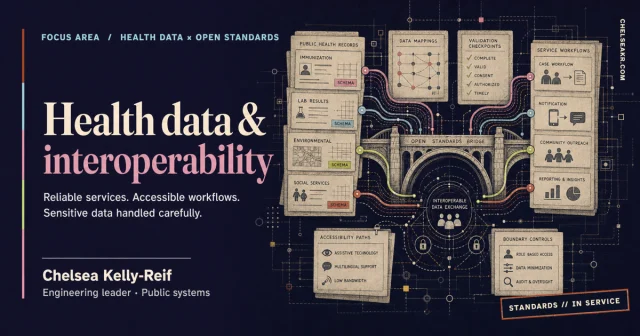
Medicaid and health-data systems
Company-wide engineering ownership spanning a seven-application Medicaid and CHIP reporting suite, Medicaid Drug Programs oversight, and FHIR interoperability.
Open source
fhir-scorecard
Maturity: Beta · v0.1.0
Plain-language operational scorecards for publicly observable FHIR endpoints, with every finding cited to FHIR R4 or SMART App Launch spec text and every endpoint, organization, and cohort on its own indexable page. Grades are deterministic and fail closed: an unreachable endpoint is an F with a reason, not a gap in the data. The registry holds 81 live-verified endpoints across 13 roster-based cohorts; the California cohort of Medi-Cal and Covered California payers records that 8 of 27 organizations publish a base URL that answers, with the reason each of the rest could not be listed. It probes only the public, unauthenticated discovery surface, never patient data, and republishes daily.
mrf-honest
Maturity: Working alpha · first graded cohort
Deterministic, spec-cited grades for hospital price-transparency files, published with the evidence attached. The first cohort is deliberately small: six machine-readable files across four health systems, five graded A and one C. That C is the launch finding: an 884 MB file that still declared the superseded 2.0.0 template more than seven months after the effective date CMS documents for v3.0, verified against CMS's own schema documentation, pinned to the file's content SHA-256, and written up alongside what cuts the other way. It grades files, never institutions, and never determines legal compliance.
Writing

A missing answer is not a no
In the Medicaid unwinding, most people who lost coverage were never determined ineligible. Their case just did not hear back, and the system recorded that the same way it records a no.
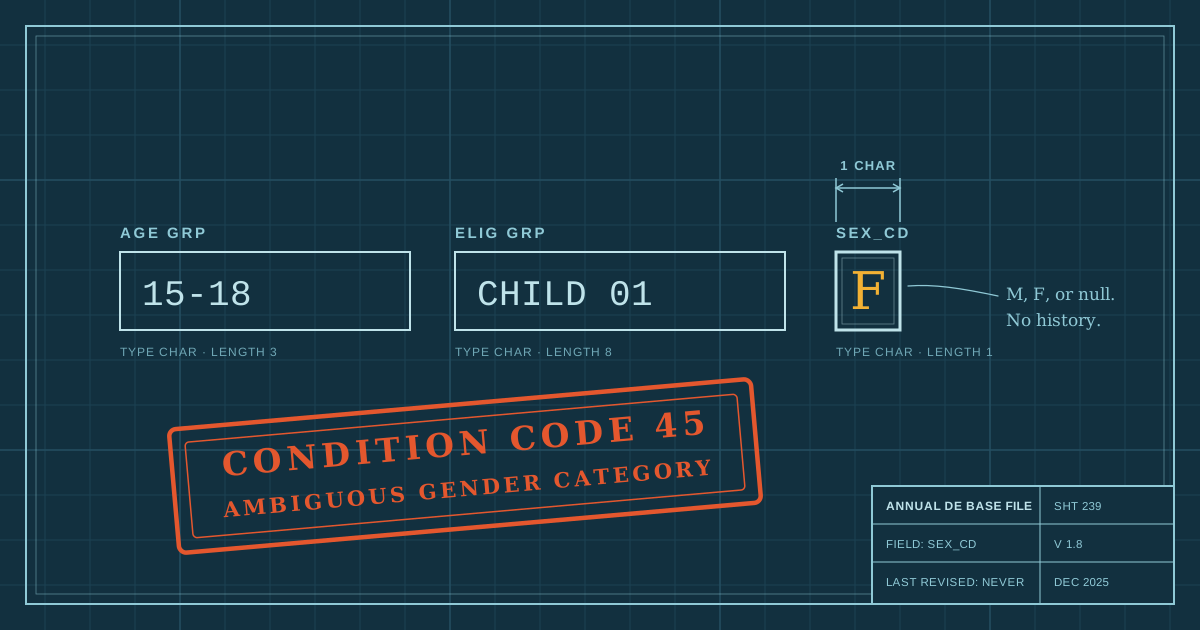
There is no value the system treats as true
The federal government has cut Medicaid funding for transgender children's care, running the exclusion through data systems I spent years helping build. The field that records who we are is one character wide, and it was never fixed.
Questions I get asked
How do you approach public-interest health-data systems?
I help teams turn reporting and service needs into maintainable software, with clear data boundaries, usable workflows, and operational ownership built into delivery.
How do open standards help?
Standards such as FHIR can make health data more portable and understandable across systems. I focus on using standards pragmatically: map the real workflow, validate the data, and document where local decisions still matter.
What quality practices matter for sensitive services?
Accessibility, security, observability, testing, and incident readiness have to be part of the delivery system rather than end-stage reviews. I make those expectations visible in architecture and team practice.
How do you lead teams in a complex domain?
I create clear decision paths, pair domain experts with engineers, and keep architecture and operational documentation close to the code so teams can learn without relying on one person.