Series: Public data and evidence
There is no value the system treats as true
The federal government has cut Medicaid funding for transgender children's care, running the exclusion through data systems I spent years helping build. The field that records who we are is one character wide, and it was never fixed.
Content note: this essay is about the federal government cutting off medical care for transgender children, and it is written by a transgender woman who spent years building the data systems the same agency runs. It is not calm.
On August 13, 2026, the Centers for Medicare and Medicaid Services published a final rule in the Federal Register (opens in a new tab). As of October 13, no state may use federal Medicaid dollars to pay for puberty blockers, hormones, or surgery for a transgender child under 18, or under 19 in a separate CHIP program. States that keep covering this care will do it with their own money or not at all. The rule runs sixty-nine pages in the Federal Register, a few of them regulatory text and the rest the agency explaining itself.
I have read all of it. I read it the way I read most CMS documents, which is as someone who used to be responsible for the software states use to report Medicaid and CHIP data back to CMS. For several years I led engineering on the suite of applications every state and territory files that data through, and I had oversight of the system behind the federal Medicaid drug rebate program. I know what a rule looks like by the time it reaches a state's claims system, because I have watched what it takes to get it there. I am also a trans woman. I have known that for as long as I have known anything about myself. I came out in 2019 while working inside California state government and wrote about what that cost. So when I say I read this rule carefully, I mean I read it twice: once as the engineer and once as the person it describes.
Here is what the rule is, in the data. Then here is what I think of it.
A rule is a configuration change
People who do not work on these systems imagine a coverage exclusion as a policy. It is not a policy by the time it matters. It is a list of diagnosis codes, a list of drug identifiers, a prior authorization rule, and a claims edit, entered into a state's Medicaid management system and into every managed care plan's adjudication logic, and then tested, or not tested, against the claims that arrive the following Monday.
CMS knows this. The final rule says states must file a state plan amendment, revise their policy documents and provider communications, update managed care plan documents, and revise their claims processing systems, all within the sixty days between publication and the effective date. It calls this "well within the normal operational capacity of State Medicaid agencies." Its paperwork estimate for the entire country adds up to 280 hours and $28,394. That is the agency's published price for rewriting the rules of fifty-six Medicaid and CHIP programs. Commenters told CMS this was an underestimate. CMS answered that the estimate "may not fully capture the scope of administrative work required" and finalized it anyway. I have been in the room when one state changed one edit. The estimate is not an estimate. It is a shrug.
Then the rule says something I want every person who has ever argued that these exclusions are "just about procedures" to read slowly. The exclusion is purpose-based. The same drug, the same surgery, is or is not a "sex-rejecting procedure" depending on why it was done. And CMS concedes, in its own words, that "standard outpatient pharmacy claims do not currently include diagnosis codes, which may make it difficult to determine at the point of dispensing whether a covered outpatient drug is being provided for a sex-rejecting purpose or another purpose."
Translate that. Estradiol is estradiol. The pill a fifty-five-year-old woman takes for menopause has the same national drug code as the pill a sixteen-year-old trans girl takes. Under the federal drug rebate program, a system I had oversight of, a state cannot simply drop that drug, because section 1927 of the Social Security Act requires covered outpatient drugs to stay on the formulary for their other uses. The rule says so. So the only way to implement this exclusion at a pharmacy counter is to make the person the disqualifier. CMS's answer is prior authorization: "we expect that prior authorization processes and utilization management tools will be the primary mechanisms through which States ensure that FFP is not claimed for sex-rejecting procedures." It tells states to build "coding edits" like the ones they already run for weight-loss drugs and sexual-dysfunction drugs.
That is the category they chose. The edit that will stop a trans kid's prescription is the same kind of edit that stops Wegovy and Viagra. I did not write that comparison. The agency did.
Nobody counted us. They counted a diagnosis.
CMS had to estimate what this rule would save. To do it, it went to T-MSIS, the national Medicaid claims and enrollment database that the state reporting I worked on feeds into, and pulled every 2023 claim for enrollees seventeen and under carrying one of six ICD-10 codes: F64.0, F64.1, F64.2, F64.8, F64.9, and Z87.890. Transsexualism. Gender identity disorder in adolescence or adulthood. Gender identity disorder in childhood. Other gender identity disorders. Unspecified. Personal history of sex reassignment.
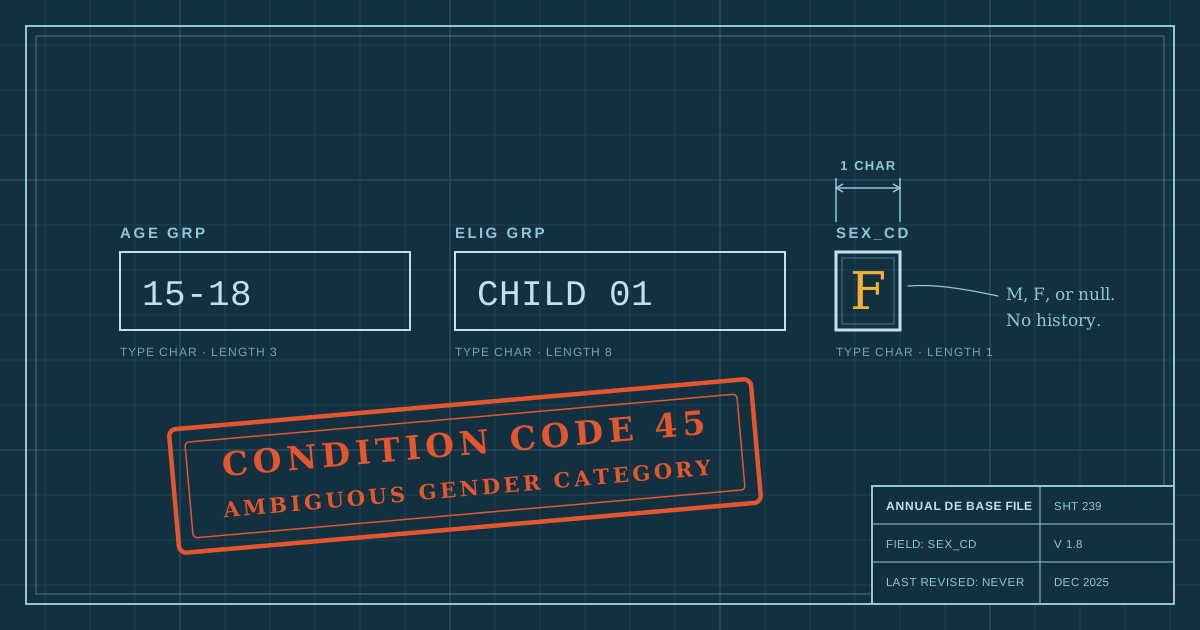
Read that list again and notice what it is. It is not a count of transgender children on Medicaid. It is a count of children whose doctor wrote down a diagnosis that the billing system would accept. CMS cannot count us any other way, because its own data cannot see us. In the codebook for the T-MSIS Analytic Files (opens in a new tab), CMS's primary Medicaid research file, the only sex field is called SEX_CD. Its label is "Sex (Biological)," qualified "Latest in Year." It is one character wide. It takes M, F, or null. The word "gender" does not appear anywhere in the 372-page document, and the field has carried that label since before any of these executive orders existed. A changed sex marker overwrites the old one. There is no history. There is no field for who a person is. There is one character, and it is whatever the state reported most recently.
So the rule that governs transgender children in Medicaid was costed against a population the agency has chosen never to measure, using the one artifact that does make us visible: the diagnosis a clinician had to record to get us care. The agency found about $31 million in total federal and state spending for 2023. Twenty-three point eight million of that was hormone therapy, and $21 million of the hormone spending was puberty blockers. Surgery, the thing the executive order's title (opens in a new tab) is about, the "surgical mutilation," was $2.4 million nationally. Inpatient surgery was $180,553. For the whole country. For a year.
Thirty-one million dollars is three one-thousandths of one percent of Medicaid. CMS says in the rule that it is not doing this for the savings. I believe that part.
The plumbing already hated us
I want to show you something older, because the rule pretends this is new and it is not.
In December 2009, CMS issued Transmittal 1877 (opens in a new tab) to its Medicare claims contractors. The problem it solved was this, in the agency's own words: "As the result of transgender and hermaphrodite issues, claims for some beneficiaries are rejecting the IOCE, and CWF due to gender specific edits. This is resulting in inappropriate denials for Part A and Part B claims." A trans man's cervical screening was hitting a sex-procedure edit and bouncing. A trans woman's prostate exam was doing the same. The number of denials was, the transmittal says, "increasing."
CMS did not fix the sex field. It created a flag. Condition code 45, whose official definition in the Medicare Claims Processing Manual reads, verbatim: "Ambiguous Gender Category. Claim indicates patient had ambiguous gender characteristics (e.g. transgendered or hermaphrodite)." A provider puts that code on the claim and the system bypasses the edits. For physician claims, CMS reused the KX modifier, a generic "requirements have been met" flag, for the same purpose. The transmittal notes that the inpatient code editor "can't make the required changes," so inpatient claims were left out. And it says, in the line every engineer who has ever worked a government system will recognize: "No additional funding will be provided by CMS."
That is the architecture this new rule is built on top of. For sixteen years, the way a transgender person's ordinary health care has cleared Medicare's sex edits is a provider-applied flag that labels us ambiguous and lumps us with a slur for intersex people, implemented for free, and not at all for inpatient claims. The field was never fixed because fixing the field would have meant admitting the field was wrong.
Now watch what the same agency does with that field in 2026. HHS published a report this month (opens in a new tab), hosted on its own website, commissioned by the department and written by contributors from the Center for Christian Virtue, the Independent Women's Forum, and the Ethics and Public Policy Center. It quotes a whistleblower's congressional testimony that a Texas hospital would "falsify medical records by listing the preferred gender identity of the patient on the medical record instead of the birth sex." Its appendix defines a "cross-sex" hormone prescription purely by mismatch: testosterone for a patient whose recorded sex is F, estrogen for a patient whose recorded sex is M. Patients with no recorded sex are excluded from the analysis. The report recommends that state Medicaid programs audit claims by ICD code and that managed care plans build parallel controls, and it points to two 2026 settlements, Texas Children's Hospital for $10 million on May 15 and Cleveland Clinic on June 5 with a $2 million commitment to "detransitioner" care, both reached on the theory that billing public payers for this care with the "wrong" codes is fraud.
So here is where a trans person on Medicaid stands in August 2026. If her sex marker says F, the word for that is now "falsified," and her estrogen is flagged as consistent with her record and therefore invisible to the audit. If her marker says M, her estrogen is a "cross-sex hormone" and a fraud indicator, and her mammogram bounces off a 2009 edit unless someone remembers to stamp her ambiguous. The one-character field is simultaneously the evidence of fraud and the mechanism of denial. There is no value you can put in it that the system treats as true.
Take the agency at its word
The rule's stated foundation is a report HHS released on May 1, 2025, reviewing the evidence on pediatric gender dysphoria. Here is what HHS itself says about that report, in the supplement it published on November 19, 2025 (opens in a new tab). The report "does not make specific policy recommendations." The report "is not a CPG," meaning not a clinical practice guideline. HHS invited three medical societies to peer review it; the American Academy of Pediatrics and the Endocrine Society declined, and the American Psychiatric Association's review said its methodology "lacks sufficient transparency and clarity for its findings to be taken at face value." The nine authors were anonymous for six months. When HHS finally named them, five of the nine disclosed payments for expert testimony or legal consulting on pediatric gender medicine.
That document is the evidentiary basis for a federal regulation that cuts off care. The agency that wrote the regulation says the document recommends no policy. Both of those things are in the Federal Register.
CMS says it received approximately 11,000 timely comments; the public docket on regulations.gov lists 34,960. More than ninety percent of what CMS counted opposed it. CMS made two changes. The first was a six-month window in which federal funds can still pay for hormones a child was already taking on October 13, but not puberty blockers, and not for anyone who starts after. Six months is the taper. After that, a seventeen-year-old who has been on hormones for two years loses federal funding for them in the middle of a school year, and whether her state picks up the cost depends on which state she was born in.
The second change is the one I cannot stop thinking about. The proposed rule (opens in a new tab) defined a "sex-rejecting procedure" as an intervention that attempts to align "a child's" body with an asserted identity. The final rule changed "child" to "individual." CMS explains this as making the definition age-neutral while keeping the funding prohibition limited to minors. But a definition is the part of a regulation that gets reused. The prohibition is one sentence that can be amended to say "any age." The definition is the machine. They did not need to change the definition to make this rule work on children. They changed it anyway.
And the rule's own definition of the word sex, now codified at 42 CFR 441.801, reads: "Sex means a person's immutable biological classification as either male or female." That sentence is in the Code of Federal Regulations now. It was written about children. It does not say children.
The doors that closed this year
If you think the courts will catch this, here is the state of the courts.
On June 18, 2025, in United States v. Skrmetti (opens in a new tab), the Supreme Court upheld Tennessee's ban on this care for minors under rational-basis review, the lowest standard there is, and declined to decide whether transgender people are a protected class at all. On March 10, 2026, the Fourth Circuit applied Skrmetti to adults (opens in a new tab): it upheld West Virginia Medicaid's exclusion of gender-affirming surgery for a class of adult enrollees and wrote, in a sentence I am going to quote exactly, "if a State can reasonably ban it, of course a State can reasonably refuse to pay for it." The same opinion held, under the Supreme Court's 2025 decision in Medina, that Medicaid enrollees have no private right to sue over what their state program covers. Enforcement belongs to the executive branch. The executive branch is the one writing the exclusions.
On October 22, 2025, a federal court in Mississippi vacated the gender-identity protections in HHS's Section 1557 nondiscrimination rule, including the specific Medicaid managed care provisions at 42 CFR 438.3(d)(4), 438.206(c)(2), and 440.262. On June 2, 2026, HHS published a notice in the Federal Register (opens in a new tab) stating that its civil rights office and CMS "cannot and will not enforce the vacated provisions." The one federal rule that said a Medicaid plan could not discriminate against me for being transgender is gone, and the agency has announced it will not pretend otherwise.
The marketplace exclusion (opens in a new tab), which unlike the Medicaid rule reaches adults, was vacated on August 14 by a federal court in Massachusetts (opens in a new tab). Read the opinion before you celebrate. The court struck it because HHS failed to send Congress an actuarial report the statute requires. It never uses the word transgender. The procedural defect is curable. The policy is not dead; it is waiting for paperwork.
The hospital rule (opens in a new tab), which would bar any Medicare- or Medicaid-certified hospital from providing this care to minors at all, is still proposed. Its public docket holds 30,893 comments. Its impact analysis counts 9,851 children on blockers or hormones in the states without bans, and about 85 surgeries a year nationally, and to get around the statute that forbids federal control over the practice of medicine, CMS wrote that providing this care to children "is not healthcare." That is the sentence they needed, so they wrote it.
And while all of that was pending, more than forty hospitals stopped. STAT counted 42 hospitals and health systems (opens in a new tab) that paused or ended some form of this care between January 2025 and February 2026. Children's Hospital Los Angeles closed a center that had operated for thirty years, effective July 22, 2025. Children's National stopped prescribing on August 30. Children's Hospital Colorado suspended in January 2026 after being referred to the inspector general. The Department of Justice subpoenaed more than twenty providers, and the subpoena to Children's Hospital of Philadelphia (opens in a new tab) demanded the names, birth dates, Social Security numbers, and addresses of every patient prescribed blockers or hormones. Nobody had to finalize a rule for that. The rule is the paperwork that arrived after the fear had already done the work.
What I know because I built it
Here is what I can tell you that the rule cannot.
I know that sixty days is not enough time to change a managed care plan's adjudication logic correctly, and that the way this will actually be implemented in most states is a blanket prior authorization flag on every GnRH agonist and every sex hormone for every enrollee under eighteen, because that is the only edit you can write in sixty days when the exclusion is about purpose and the claim does not carry purpose. Which means the kid with precocious puberty, the carve-out the rule is so proud of, is likely to get caught in the same net and wait the same weeks.
I know that the reporting instruments I led engineering on cannot see what this rule does. The forms states file with CMS roll up enrollment and spending by age and by eligibility group, and the national claims file underneath them carries sex as one character. When the state plan amendments are filed and the edits go live on October 13, there will be no number in any federal report that says how many children lost care, because there is no field in which to record them. CMS will be able to report the savings. It will not be able to report the cost. That is not an accident of the data. That is what a field labeled "Sex (Biological)" was always going to produce.
I know what it means that the definition says "individual." I have read enough regulations to know which sentence gets amended next.
And I know this, which is not about data at all. I have always known I am trans. Not since 2019, when I said it out loud in a state office building and paid for it. Always. The children this rule is about know it too, and they know it at an age when the adults around them are still calling it a phase, and the ones who get care are the ones whose parents and doctors believed them. The federal government has now written into the Code of Federal Regulations that what those children know about themselves is an "asserted identity that differs from" what it has decided they immutably are. It has done this on the basis of a report its own authors say recommends nothing, over the objection of ninety percent of the people who wrote in, to save three one-thousandths of a percent of a program, using a data model that cannot count the people it is counting out.
I built part of the plumbing. I am not going to pretend that gives me clean hands or a neutral seat. It gives me the receipts, and the receipts say this was not a bug. A bug is an outcome nobody chose; I fixed those for a living. Every outcome here was chosen, and every choice has a signature on it. Somebody adopted an evidence report its own authors say recommends nothing. Somebody priced the defunding of fifty-six programs at 280 hours of paperwork. Somebody swapped "child" for "individual" in the definition so the machine would be ready for the rest of us. Somebody has had sixteen years to fix a one-character field and chose instead to teach it to read estrogen as fraud. The system is behaving exactly as configured. The people who configured it knew what it would do, and the data model they kept guarantees no federal report will ever show it happening.
The field is one character wide. The cruelty is not.