Permit Bearings: know the path in
Role: Independent product designer and engineer · 2026
I designed and deployed a California housing-permitting prototype that screens a bounded statewide ADU, JADU, and SB 9 baseline across 541 recognized jurisdictions and produces a printable handoff for local staff. Woodland remains the deep synthetic packet fixture; no applicant, planner, or jurisdiction has validated it.
Evidence boundary
- Built
- A statewide screening prototype and printable handoff for local staff
- Observed
- 541 registry entries, 17 candidate rules, a 25-item Woodland fixture, and 31 browser checks
- Not proved
- Applicant, planner, jurisdiction, approval, adoption, or housing outcome validation
Selected measures
- recognized California cities and counties sharing the statewide screening baseline
- 541
- statewide candidate-rule records, not a complete statement of law
- 17
- source-bound items in the synthetic Woodland packet fixture
- 25
- browser checks after the statewide handoff shipped
- 31
- applicant, planner, or jurisdiction validations
- 0
Permit Bearings (opens in a new tab) helps a person get oriented before filing: enter structured project facts, see candidate state pathways and their sources, learn where local coverage stops, and take unresolved questions to staff. It is deployed and executable. It is also a prototype: it does not verify a parcel, reproduce a complete local code or checklist, certify completeness or eligibility, or predict approval.
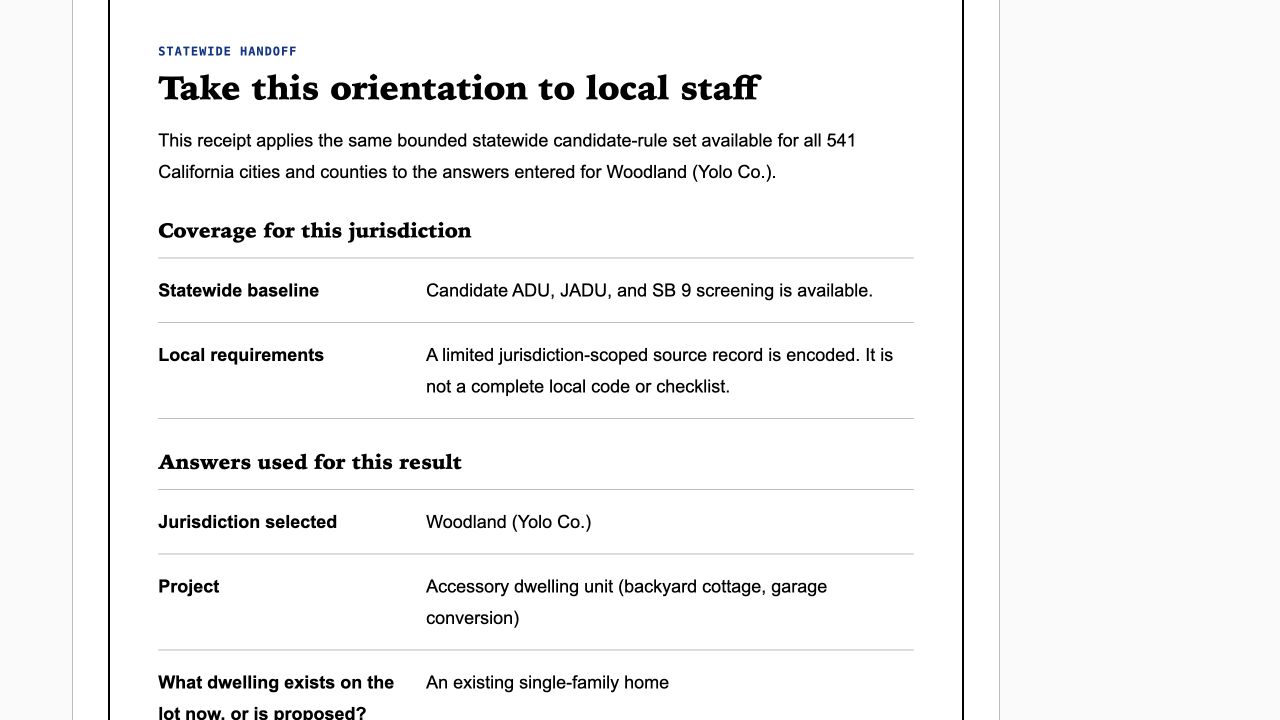
The resident is the main character
Permitting products often begin with an agency workflow or a chatbot. I began with the resident's job: understand the likely path, preserve the facts used, see the evidence behind each candidate result, and know exactly what still requires local judgment. The interface turns uncertainty into a staff question instead of silently choosing the favorable answer.
One statewide architecture, honest local depth
- All 541 registry entries—483 incorporated cities and 58 counties—can use the same bounded statewide candidate-rule set. Its source layer begins with California HCD's ADU Handbook (opens in a new tab) and SB 9 housing-law fact sheet (opens in a new tab).
- Every recognized jurisdiction receives a bilingual, print-focused orientation receipt with the facts used, candidate-route sources and currency, the local-coverage boundary, and questions for staff.
- Davis (opens in a new tab) and Woodland (opens in a new tab) have bounded local source records; neither is represented as comprehensive local-code coverage.
- Only the made-up Woodland journey continues into the 25-item packet-presence workflow. That depth is a pilot fixture, not a statewide checklist.
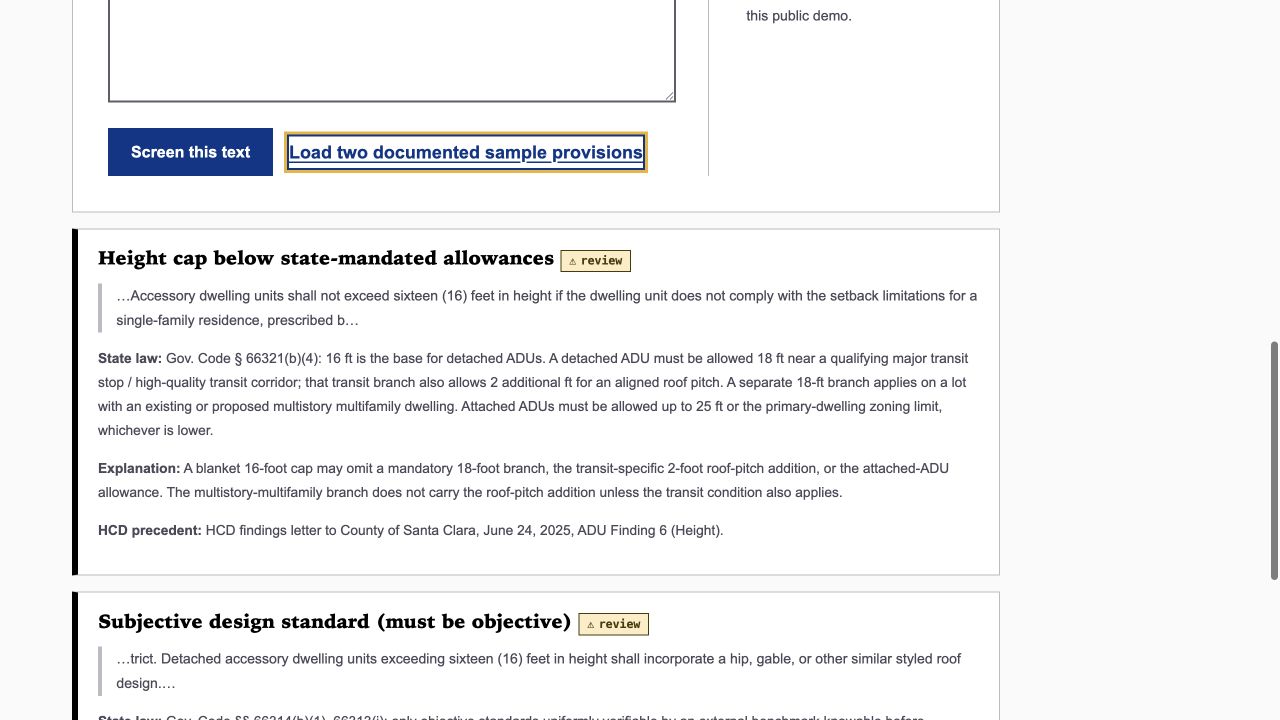
Trust is a product behavior
- A material “I'm not sure” answer blocks the candidate path and becomes a direct question for staff.
- Every matched record keeps its official citation and source-review status visible; stale or unverified evidence withholds action-oriented copy.
- The browser stores no applicant record. The printable statewide receipt is built only from current page memory.
- AI-assisted explanations, checklist mappings, actions, and Spanish translations remain visibly review-pending unless an exact review record says otherwise.
The pair: know the path in, test the path out
Permit Bearings asks whether a public process can preserve agency at the beginning: show the route, evidence, gaps, and questions before filing. ExitDrill (opens in a new tab) asks the complementary question at the end of a system relationship: can an organization recover the declared structure of its own synthetic data? Permit Bearings does not approve a project. ExitDrill does not prove operational equivalence or migration readiness. Together they express one thesis: public systems should preserve human and institutional agency.
How the product evolved
The first complete slice followed one synthetic Woodland project from structured facts to candidate route, source-bound packet presence, preparation actions, staff questions, and a printable summary. The next iteration separated that deep local fixture from the statewide product contract: every recognized California city and county now receives the bounded state-rule orientation and staff handoff, while local depth remains visibly limited. A version-bound evidence gate (opens in a new tab) was added before any external review so later feedback can be tied to the exact product and source state people saw.
Submitted to California's Innovation Showcase
I submitted Permit Bearings to California's 2026 AI Permitting Innovation Showcase (opens in a new tab). The prototype primarily addresses applicant guidance and contributes a bounded source-currency layer: structured facts produce a source-linked candidate route and questions for staff, while selected source changes can invalidate dependent records. It does not target full internal entitlement or building review, certify a complete application, or encode comprehensive local law. The submission went in before the Intent to Showcase window closed on August 11, 2026. The Showcase is market research—not procurement—and submission does not mean selection, state endorsement, an award, a contract, or deployment.
Candidate matching is deterministic. AI-assisted explanations, translations, checklist mappings, and action drafts are versioned, review-pending sidecars that cannot create or change a match.
Evidence available today
The deployed merge passes 301 Python tests at 86.92 percent branch coverage, 29 structured golden scenarios, 31 browser checks, dependency and security gates, a source-integrity harness, and Lighthouse budgets. Those results support the implementation claim. They do not establish legal accuracy, applicant usefulness, staff acceptance, accessibility signoff, Spanish semantic parity, adoption, or housing outcomes.
The external-evidence gate is prepared, not run: future two-reviewer content review, six same-version sessions, manual accessibility and Spanish checks, a timed source-change rehearsal, and a partner decision are all still not run or pending. The honest flagship claim is product judgment plus a reproducible technical contract—not validated public impact.
Inspect the public evidence and limits page (opens in a new tab), the Permit Bearings repository (opens in a new tab), and the complementary ExitDrill technical alpha (opens in a new tab).